
In an era where geopolitics balance delicately on the edge of diplomacy and deterrence, the possession and proliferation of nuclear weapons remain among the most pressing issues in international relations. As of 2025, nine countries officially possess nuclear weapons, each wielding these formidable arsenals as both shields and symbols of power. But how does this nuclear club look today, and importantly, do nations like Canada or Mexico harbor nuclear capabilities? Let’s unpack the current landscape with a clear eye and casual tone.
The Core Nuclear Club: Who Owns What?
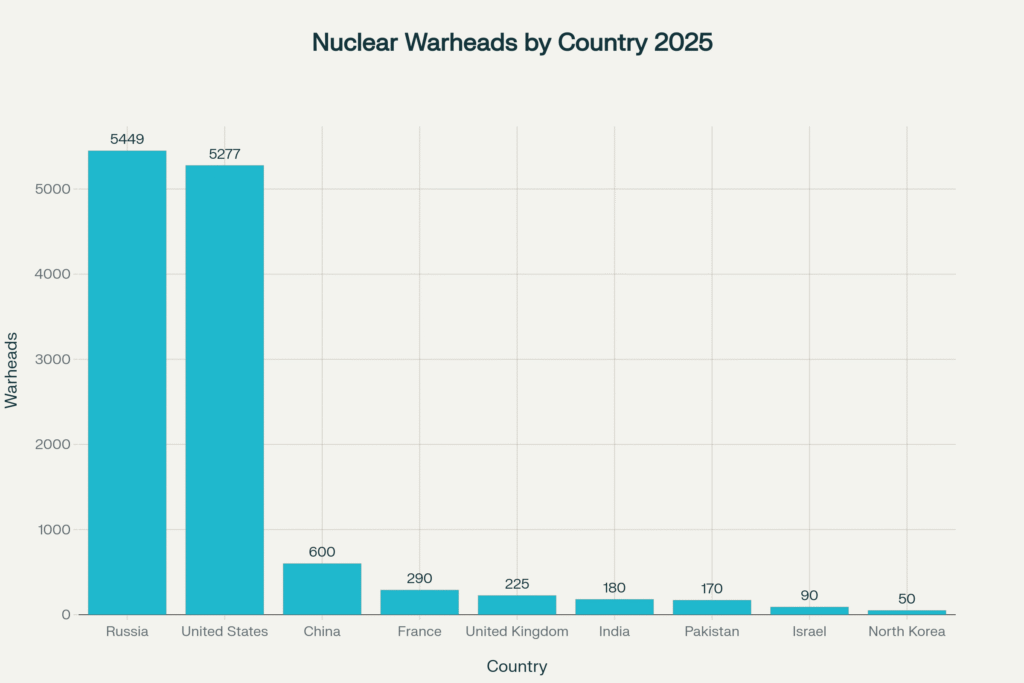
Global nuclear arms are heavily concentrated. According to the Federation of Atomic Scientists and the SIPRI 2025 report, these nine countries hold approximately 12,331 nuclear warheads worldwide. The breakdown is a stark reminder of Cold War legacies, emerging powers, and ongoing arms competition.
| Rank | Country | Estimated Nuclear Warheads (2025) |
|---|---|---|
| 1 | Russia | 5,449 |
| 2 | United States | 5,277 |
| 3 | China | 600 |
| 4 | France | 290 |
| 5 | United Kingdom | 225 |
| 6 | India | 180 |
| 7 | Pakistan | 170 |
| 8 | Israel | 90 |
| 9 | North Korea | 50 |
| Total | 9 countries | 12,331 warheads |
Here’s the rundown of the countries with nuclear weapons, ranked by their estimated stockpiles:
-
Russia – Leading the pack with about 5,449 warheads. Russia’s arsenal is a mix of strategic bombers, submarines, and land-based missiles, a holdover from Soviet days. Under President Vladimir Putin, it’s not just about quantity; they’re upgrading to hypersonic tech that could outpace defenses.
-
United States – Close behind with 5,044 to 5,277 warheads. The U.S. spreads its nukes across silos in the Midwest, subs in the oceans, and bombers ready to fly. It’s the only country to have used them in war (Hiroshima and Nagasaki in 1945), and today, it’s investing billions in modernization amid rivalries with China and Russia.
-
China – Rapidly expanding to around 600 warheads. Beijing’s buildup is the talk of the town—up 100 from last year alone. Think sleek new missiles and subs; it’s all part of Xi Jinping’s push for “great power” status, eyeing tensions in the South China Sea.
-
France – Steady at 290 warheads. France’s “force de frappe” relies on submarines and air-launched missiles. It’s fiercely independent, opting out of NATO’s nuclear sharing to keep full control.
-
United Kingdom – Holding 225 warheads. The UK’s Trident system is submarine-based, with close ties to U.S. tech. Post-Brexit, it’s reaffirming its global role, but budget debates rage on.
-
India – Around 180 warheads. India’s “no first use” policy focuses on deterrence against neighbors like Pakistan and China. Recent tests of Agni missiles show a creative blend of homegrown tech and strategic caution.
-
Pakistan – Estimated at 170 warheads. Pakistan’s arsenal is tactical and mobile, designed for quick response in regional conflicts. It’s a wildcard in South Asia, with ongoing rivalries fueling arms races.
-
Israel – Unofficially, about 90 warheads. Israel plays it coy with a policy of “ambiguity,” neither confirming nor denying. Its nukes are seen as a last-resort shield in a volatile Middle East.
-
North Korea – Roughly 50 warheads. Kim Jong-un’s program is secretive and provocative, with missile tests that rattle neighbors. It’s less about global dominance and more about regime survival
Does Canada Have Nuclear Weapons?
A common question arises about Canada’s nuclear stance: Does Canada have nuclear weapons? The answer is an emphatic no.
Canada does not possess nuclear weapons and is a fervent advocate for nuclear disarmament. As a signatory to the Treaty on the Non-Proliferation of Nuclear Weapons (NPT), Canada has committed itself to a non-nuclear weapons policy. Historically, during the Cold War, Canadian territory hosted NATO nuclear weapons as part of collective defense agreements, but Canada never independently owned or developed nuclear arms.
Instead, Canada channels its efforts toward peaceful nuclear technology, disarmament diplomacy, and global security initiatives. It is also one of the proponents of the Treaty on the Prohibition of Nuclear Weapons (TPNW) and actively supports UN resolutions aimed at reducing nuclear risks.
Does Mexico Have Nuclear Weapons?
Similarly, the question, Does Mexico have nuclear weapons? sees an equally definitive response: no.
Mexico follows a staunch non-nuclear policy. It is a party to international treaties forbidding nuclear arms development and promotion. Additionally, the Treaty of Tlatelolco, established in 1967 and signed by Mexico, created a nuclear-weapon-free zone in Latin America and the Caribbean. This treaty cements Mexico’s stance against nuclear weapons and promotes regional peace.
Mexico’s defense policy focuses on conventional forces and regional cooperation, underpinned by a firm commitment to non-proliferation and disarmament.
Why Do Nuclear Weapons Matter?
Nuclear weapons symbolize unmatched military power and deterrence capability. Their destructive potential is unparalleled, which has driven global efforts for arms control, treaties, and dialogues aimed at preventing nuclear war. The doctrine of mutually assured destruction (MAD) continues to shape diplomatic relations, especially among the major nuclear powers.
At the same time, the presence of nuclear weapons raises significant ethical, environmental, and humanitarian concerns. Debates rage about the morality of maintaining such arsenals and the risks of accidental or intentional use.
Emerging Trends and Concerns in 2025
The landscape of nuclear weapons is not static. Recent years have seen fluctuations:
-
China’s rapid buildup: China’s stockpile has increased by around 20% in the last year, now estimated at 600 warheads. This significant growth signals strategic positioning amid rising tensions in the Indo-Pacific region.
-
Modernization: Countries like Russia, the U.S., France, and India are investing in more advanced missile systems, hypersonic delivery methods, and diversified nuclear triads encompassing air, land, and sea.
-
North Korea and Israel: Both maintain smaller but potent arsenals. North Korea’s unpredictable testing continues to alarm the global community, while Israel preserves a policy of ambiguity, neither confirming nor denying its nuclear status.
-
Disarmament talks: The Treaty on the Prohibition of Nuclear Weapons (TPNW) is gaining attention but remains unsigned by nuclear powers. The international community’s goal of eventual disarmament faces considerable geopolitical obstacles.
The Role of Non-Nuclear Countries
Countries like Canada and Mexico exemplify a contrasting position in global nuclear politics. Advocating disarmament and non-proliferation, they push for diplomatic solutions and foster nuclear-weapon-free zones. Their policies highlight the global diversity of security strategies and the ongoing tension between deterrence and peace.
Final Thoughts on Nuclear Weapons and Global Security
As the world steps further into the 21st century, nuclear weapons remain paradoxically a symbol of both ultimate power and existential risk. The balance between deterrence and disarmament continues to shape international relations, with countries like the U.S. and Russia maintaining large arsenals while smaller nations promote peace.
Understanding who owns these weapons, and the policies of neighboring non-nuclear states like Canada and Mexico, offers clearer insight into the fragile global landscape. The future depends on diplomacy, technological change, and the shared hope that these devastating weapons will never be used again.